
Accredited 12-Lead & Diagnostic ECG Education
Master 12-Lead ECG Interpretation with Clinical Confidence
A structured, case-based ECG program for physicians, nurses, paramedics, and allied health professionals who need to recognize high‑risk patterns quickly, avoid missed diagnoses, and communicate findings with clarity on the front line.
Next cohort starts: March 3, 2026 · Live + self‑paced · Certificate of completion
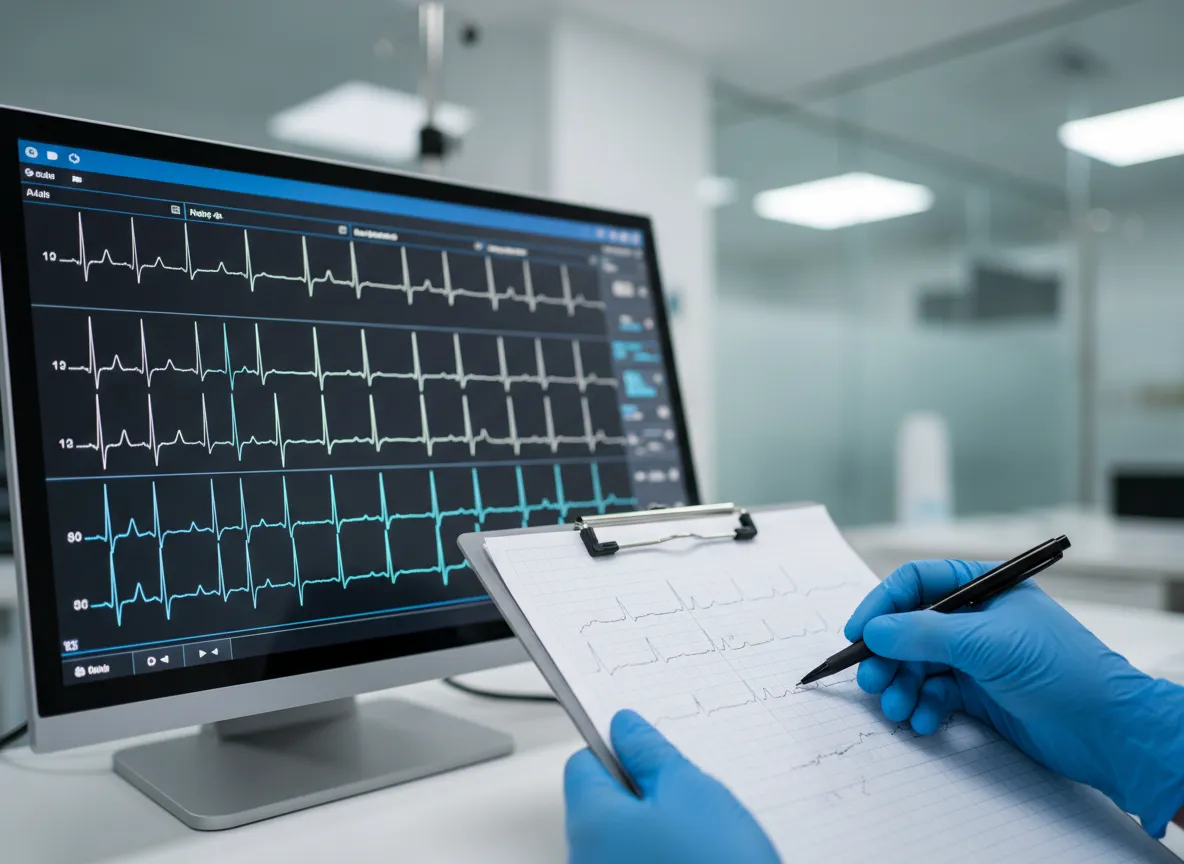
Build a repeatable mental model for rhythm analysis, axis, intervals, ischemia patterns, bundle branch blocks, hypertrophy, electrolyte changes, and more—using real cases, not abstract theory.
Trusted by clinicians from emergency departments, cath labs, critical care, primary care, and EMS systems worldwide.
Turn ECG Anxiety into Clinical Clarity
Designed for working clinicians, this program compresses years of trial-and-error into a practical, clinically focused framework you can apply on your next shift.
Outcome 01
Rapidly spot life‑threatening patterns
Develop a stepwise approach to quickly rule in or out STEMI, STEMI equivalents, dangerous arrhythmias, hyperkalemia, and other time‑critical patterns.
Outcome 02
Move beyond pattern memorization
Understand the physiology behind each ECG change so you can interpret atypical, complex, or noisy tracings—not just textbook examples.
Outcome 03
Communicate with authority
Use standardized language, structured reporting, and clear recommendations so colleagues trust—and act on—your interpretation.
Built for high‑stakes clinical environments
You’ll get the most from this program if you routinely make, influence, or act on ECG‑driven decisions in time‑sensitive settings.
- Emergency and internal medicine physicians
- Nurse practitioners and physician associates
- ED, ICU, telemetry, and cardiac nurses
- Paramedics, advanced EMTs, and EMS educators
- Cardiology fellows and residents
- Primary care clinicians who routinely order ECGs
By the end of the program, you will be able to:
- Apply a consistent 10‑step read to every 12‑lead
- Differentiate STEMI from mimics with confidence
- Recognize subtle ischemia and posterior MI
- Interpret wide‑complex tachycardias systematically
- Spot high‑risk electrolyte and drug‑induced changes
- Document interpretations with clear, defensible language
No prior advanced cardiology training is required. We start with fundamentals and quickly move into complex, realistic cases.
Curriculum: From Fundamentals to Complex Diagnostics
Live sessions, on‑demand modules, and case libraries are structured into clear blocks so you can track your progress and revisit key concepts anytime.
Module 1
ECG Foundations & Systematic Approach
Lead systems, vectors, waveform anatomy, calibration, and a reproducible 10‑step framework you’ll use in every subsequent module.
Module 2
Rhythms, Conduction, and Axis
Sinus vs. atrial vs. junctional vs. ventricular rhythms, AV blocks, bundle branch blocks, and axis determination with real‑world strips.
Module 3
Ischemia, Injury, and Infarction
ST‑segment analysis, reciprocal changes, STEMI mimics, posterior and right‑sided infarctions, and dynamic serial ECG interpretation.
Module 4
Chambers, Hypertrophy, and Structural Disease
Voltage and repolarization patterns in LVH and RVH, strain vs. ischemia, pericarditis, myocarditis, cardiomyopathies, and pulmonary embolism clues.
Module 5
Electrolytes, Drugs, and Special Situations
Hyper/hypokalemia, hypocalcemia, digoxin effect and toxicity, channelopathies (Brugada, long QT), and pre‑excitation (WPW).
Module 6
Integration, Pitfalls, and Board‑Style Cases
High‑yield review, common misreads, medico‑legal lessons, and timed practice sets with debrief to solidify a durable, real‑world skillset.
Plus: lifetime access to updates, downloadable PDFs, case library expansions, and annotated ECG packs you can use for teaching.

Lead Educator - virtual Education Specialist.
Chris Hardcastle
Chris has interpreted tens of thousands of ECGs over his 29+ years in emergency medicine and pre-hospital EMS systems. He teaches ECG interpretation to residents, fellows, and EMS systems across North America.
- Former ECG education lead at a Level I trauma center
- Curriculum director for a multi‑hospital STEMI network
- Invited lecturer for national EM and cardiology conferences
- Co‑author of multiple peer‑reviewed ECG case reports
A teaching style built around how clinicians actually think
Instead of isolated pattern recognition, you’ll learn to anchor each tracing to the clinical story, vital signs, and the decisions you need to make in the next 5 minutes.
Sessions combine short, focused teaching blocks with live interpretation walk‑throughs, cold‑read drills, and Q&A, plus optional office hours for tricky cases from your own practice (with PHI removed).
“Our emergency department’s miss rate on subtle ischemia and ECG documentation disputes dropped noticeably after we rolled out Dr. Ellis’ approach across our provider group.”
— Medical Director, Regional STEMI Program
Group and institutional training options are available for residency programs, EMS agencies, and hospital systems.
What clinicians say after the program
Over 1,200+ clinicians trained across emergency, cardiology, and pre‑hospital care.
“I went from skimming the computer’s interpretation to confidently disagreeing with it when it’s wrong. The systematic approach sticks—even at 3 a.m. in a crowded ED.”
— Emergency Medicine PA
“The case library alone is worth the tuition. I finally understand why certain ST changes matter and others don’t, and my cardiology consults are much more focused.”
— Hospitalist, Internal Medicine
“Our paramedics now call cleaner, earlier STEMI alerts with fewer false activations. The shared language from this course improved handoffs from field to cath lab.”
— EMS Medical Director





Academic medical centers · Community hospitals · EMS systems · Telemedicine groups
Enroll in the 12‑Lead & Diagnostic ECG Education Program
Secure your spot in the upcoming cohort. Seats are limited to keep live sessions interactive and case discussions focused.
Secure checkout · Payment plans available at enrollment · Risk‑free 14‑day money‑back guarantee for individual clinicians.
Frequently asked questions
How much time should I plan to spend each week?
Most clinicians spend 2–3 hours per week on the core modules plus 60–90 minutes for the optional live case sessions. All sessions are recorded, and you can move faster or slower depending on your schedule.
Will this count for continuing education credit?
The program is designed to be CME‑eligible and has been previously accredited through partner organizations. Accreditation details may vary by cohort and jurisdiction; we’ll provide documentation for you to submit to your licensing or credentialing body.
What if I’m new to ECG interpretation?
You don’t need advanced cardiology training. We start with fundamentals and scaffold complexity using a single, repeatable framework that works for beginners and experienced clinicians who want to close gaps.
What if I can’t attend the live sessions?
All live teaching and case conferences are recorded and available on‑demand within 24 hours. You’ll keep lifetime access to the recordings and materials, including future curriculum updates.
Do you offer discounts for residents, students, or large teams?
Yes. We offer reduced pricing for residents, fellows, and trainees, as well as volume discounts for groups of 5 or more. Submit the form on this page and our team will follow up with options tailored to your setting.
Request syllabus or group pricing
Share a bit about your role and setting, and we’ll send program details, sample lessons, and pricing tailored to individuals or teams.
We typically respond within one business day. No spam—just program information and options for your situation.
Your next ECG doesn’t have to feel uncertain
Join a cohort of clinicians who want ECGs to be a strength—not a liability—so they can make safer, faster decisions for their patients.
Questions about fit, CME, or logistics? Submit the form above and we’ll help you decide whether this program matches your goals.